
Handheld Jammer
A one-handed RF jamming device for close-proximity drone neutralisation. Draw, activate and deny — no configuration, no setup, no delay. Built for the final defensive moment, when a drone is already inside the immediate environment of a protected person, vehicle or space.
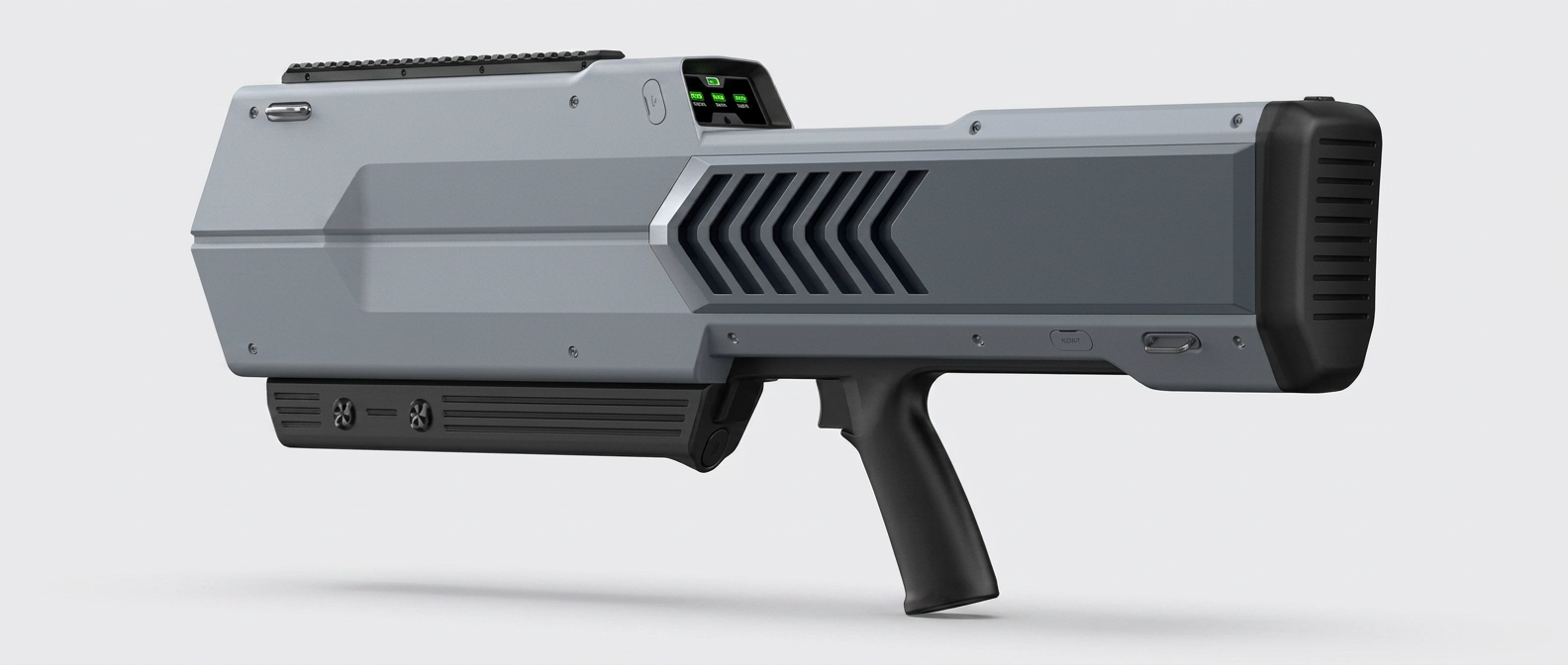
- Effective radius
- ~10 m
- Operating time
- 30 min
- Dimensions
- 20 × 15 cm
- Activation
- <1 s
Close-proximity denial
At full output
5 cm depth
Immediate readiness
Role & scope
The handheld jammer fills the gap larger systems cannot cover: the moment a drone has already breached an outer perimeter and is operating within immediate proximity of a protected person, vehicle or space. At that range a 1 km backpack system and an 8 km fixed installation both overshoot. This device is sized and activated for that precise window — a last-resort, close-contact tool rather than a perimeter solution, most effective in the hands of personnel already next to the threat: close-protection officers, door security, or first responders at an active incident.
- Innermost layer: GNSS (8–10 km) → Drone Wall (50 m–8 km) → backpack (1 km) → handheld (~10 m)
- Deployed by personnel already in proximity to the threat
- Not a replacement for outer detection or denial layers
How it works
The device emits broadband RF noise across drone control and video transmission frequencies within its operational radius. Any drone inside effective range loses its uplink to the operator, its ability to transmit video and its ability to receive new commands. The airframe's onboard failsafe then determines its behaviour — typically a hover, descent or return attempt.
- No configuration required — single-action activation, all bands pre-enabled from the factory
- Continuous carry design — worn or carried through a full duty cycle without holstering or stowage
- 30-minute operational window — matched to a principal movement, event ingress or incident response
- Urban and indoor suitability — the short radius covers the threat without RF spillover into adjacent floors or public areas
Operational use cases
- VIP & close protection — activate inside the protective bubble without breaking position
- Indoor security operations — buildings where larger equipment cannot be brought in
- Law enforcement response — deny a drone's surveillance and transmission before specialist teams arrive
Operator considerations
- Battery endurance — 30 minutes at full output; carry a spare or activate only on a confirmed threat
- RF spillover awareness — mobile, Bluetooth and 2.4/5 GHz devices in radius are disrupted during activation
- Training requirement — minimal; no RF knowledge needed beyond activation and escalation policy
- Regulatory status — supplied to authorised government, law enforcement and licensed security organisations only
Technical specifications
- Dimensions
- 20 × 15 × 5 cm
- Power source
- Integrated rechargeable battery
- Operating time
- 30 minutes at full output
- Effective radius
- ~10 metres (environment-dependent)
- Activation
- Single-action, immediate — no boot sequence
- Operator training
- Minimal — no RF knowledge required
- Deployment mode
- Handheld, single-operator, continuous carry
- Suitable environments
- Urban, indoor, confined spaces, vehicle interiors
- Integration
- Standalone last-layer device; compatible with BPNE system architecture
- Authorised use
- Government, law enforcement and licensed security organisations
Other products
Drone Wall
High-power directional RF denial system engineered for concentrated, sustained disruption across all primary drone-relevant frequency bands — from the 2.4GHz range through 6.4 GHz with a range of 10 km. NATO tested.
GNSS Jammer
A high-power multi-band GNSS jamming system that denies satellite navigation to drone platforms at distances of up to 10 km. Designed as an outer-layer effector, it degrades positioning accuracy before threats reach the protected zone — effective against both purely GNSS-reliant and inertially assisted platforms.
Mobile Backpack Jammer
A wearable, dismounted RF jamming platform that puts mid-range drone denial capability in the hands of a single operator. Covering five frequency bands simultaneously, the system disrupts drone control links, video feeds and Wi-Fi-based communication protocols from within a compact, field-ready backpack form factor.
Drone Eye
Drone Eye is a fully passive radio-frequency detection sensor. It listens across 70 MHz to 6 GHz, fingerprints drone and remote-controller emissions against a library of 130+ airframes, and reports bearing and identity without radiating a single watt — so the sensor itself is undetectable and needs no frequency licence.
EchoGuard 4D Radar
EchoGuard is a compact, solid-state 4D surveillance radar built on metamaterials electronically scanned array (MESA) technology. BPNE integrates it as the active detection layer, adding precise range, altitude and velocity to the passive RF picture — including against drones flying without an RF link.
BPNE Tracer
BPNE Tracer is a fully portable passive detection device combining protocol decoding and RF signature recognition. By reading the drone's own data link it identifies brand, model and serial number, and fixes the position of both the aircraft and its operator — without emitting anything or disturbing communications inside the protected area.
360 3D AI Radar
Portable 3D drone radar with 360° coverage and AI classification.
Command & Control
NATO Tested and certified, open architecture Command & Control platform with a common operating picture (COP) that fuses every sensor and effector, applies rules of engagement and logs each incident. Works with any sensors and any effector such as jammers, interceptors, alert systems, and third-party C2 / C4ISR systems which can be connected and commanded through the same interface. The platform is interoperable and acts as the integration layer between hardware and operational outcome.
Latest news
BPNE becomes the first Hungarian company with a NATO SAPIENT certificate
At NATO TIE26 in the Netherlands, the vendor- and sensor-neutral BPNE C2 platform was validated in a multinational, multi-vendor environment and earned a NATO SAPIENT certificate.
Read moreSwarm defeated by high-power EW at NATO Crucible 1-26 (Eastern Phoenix)
As the only Hungarian company on site, BPNE neutralised a coordinated drone swarm with high-power electronic warfare at NATO's LCI-X Eastern Phoenix experimental C-UAS exercise in Romania.
Read moreDrone-enabled operational concept for Firestone Liberia
BPNE supported Bridgestone Corporation / Firestone Liberia with a drone-enabled operational concept for one of the world's largest plantation environments — persistent aerial coverage across vast, remote tropical terrain.
Read more