
Mobile Backpack Jammer
A wearable, dismounted RF jamming platform that puts mid-range drone denial capability in the hands of a single operator. Covering five frequency bands simultaneously, the system disrupts drone control links, video feeds and Wi-Fi-based communication protocols from within a compact, field-ready backpack form factor.
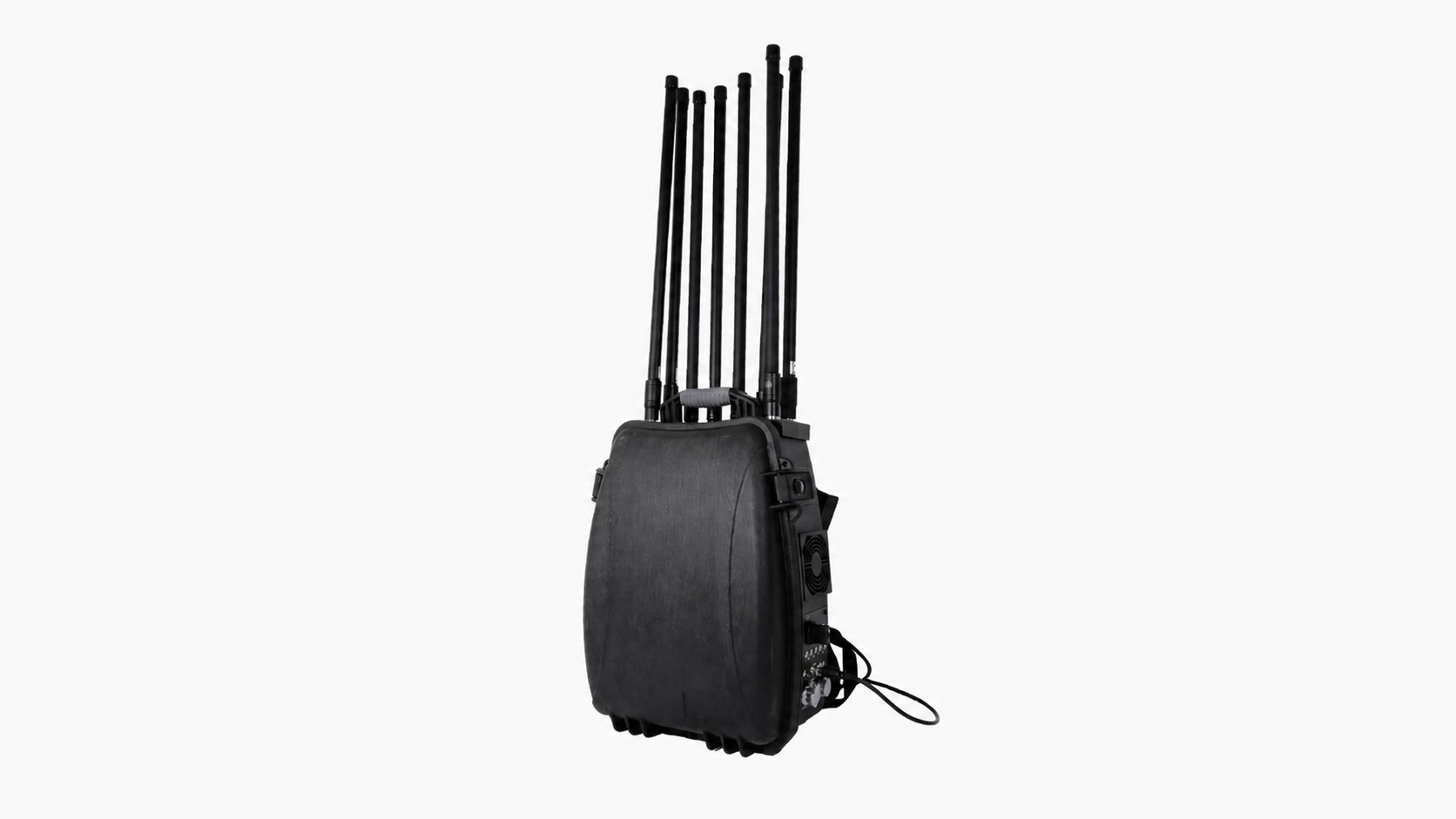
- Disruption range
- 1 km
- Output power
- 50 W
- Active bands
- 5
- Form factor
- 30 × 40 × 20 cm
Environment-dependent
Per frequency band
Simultaneous
Backpack-integrated
Operational concept
Engineered for scenarios where a fixed or vehicle-mounted system cannot be positioned in time, or where the operational area changes faster than infrastructure can be deployed. A single dismounted operator carries effective RF denial through the full mission cycle — staging, approach, the active threat window and withdrawal.
- Mid-layer effector: outer (GNSS · 8–10 km) → mid (backpack · 1 km) → inner (fixed · 8 km)
- Operators move continuously while the jammer remains active
- No site preparation, power infrastructure or communications run required
Configurable frequency allocation
The system supports operator-defined frequency configuration, allowing bands to be enabled, disabled or power-weighted based on the local threat profile, frequency coordination requirements or battery conservation priorities.
- Threat-matched output — prioritise 2.4 and 5.8 GHz against DJI platforms, or weight 400 MHz against long-range RC
- Frequency deconfliction — selectively disable bands used by friendly comms, first responders or broadcast
- Power management — fewer active bands extends battery life for longer patrols
Operational use cases
- Tactical field units — squad-level RF denial without vehicle or command post support
- Temporary infrastructure protection — drone-exclusion envelope around FOBs, fuel points and logistics hubs
- Event & VIP route security — a moving denial bubble covering entry and egress routes
- Counter-UAS fill coverage — reposition to close dead zones in layered architectures
Frequency bands & denial targets
- 400 MHz
- Sub-GHz control — long-range RC links, legacy command channels, sub-1 GHz FPV · 50 W
- 2.4 GHz
- Primary Wi-Fi — DJI OcuSync / O3, Autel SkyLink, 2.4 GHz RC transmitters · 50 W
- 5.2 GHz
- Wi-Fi / video (low) — mid-band control and video downlink channels · 50 W
- 5.8 GHz
- Wi-Fi / video (high) — FPV analogue and digital video, high-bandwidth data links · 50 W
- 6.2 GHz
- Emerging Wi-Fi 6E — next-generation commercial drone control and video · 50 W
- Total
- 5 bands active, simultaneous continuous output · 250 W
RF performance
- Frequency bands
- 400 MHz / 2.4 GHz / 5.2 GHz / 5.8 GHz / 6.2 GHz
- Output power
- 50 W per active frequency band
- Total output
- 250 W with all bands active
- Effective range
- Up to 1 km (environment-dependent)
- Band configuration
- Operator-selectable; all bands or custom subset
- Simultaneous operation
- All active bands transmit concurrently
Physical & integration
- Form factor
- Tactical backpack-integrated unit
- Dimensions
- 30 × 40 × 20 cm
- Deployment mode
- Dismounted, vehicle-assisted or static emplacement
- Setup time
- Seconds — no infrastructure or site preparation
- Detection integration
- Compatible with BPNE Tracer and external C-UAS sensors
- C2 integration
- Integration-ready with command and control systems
Other products
Drone Wall
High-power directional RF denial system engineered for concentrated, sustained disruption across all primary drone-relevant frequency bands — from the 2.4GHz range through 6.4 GHz with a range of 10 km. NATO tested.
GNSS Jammer
A high-power multi-band GNSS jamming system that denies satellite navigation to drone platforms at distances of up to 10 km. Designed as an outer-layer effector, it degrades positioning accuracy before threats reach the protected zone — effective against both purely GNSS-reliant and inertially assisted platforms.
Handheld Jammer
A one-handed RF jamming device for close-proximity drone neutralisation. Draw, activate and deny — no configuration, no setup, no delay. Built for the final defensive moment, when a drone is already inside the immediate environment of a protected person, vehicle or space.
Drone Eye
Drone Eye is a fully passive radio-frequency detection sensor. It listens across 70 MHz to 6 GHz, fingerprints drone and remote-controller emissions against a library of 130+ airframes, and reports bearing and identity without radiating a single watt — so the sensor itself is undetectable and needs no frequency licence.
EchoGuard 4D Radar
EchoGuard is a compact, solid-state 4D surveillance radar built on metamaterials electronically scanned array (MESA) technology. BPNE integrates it as the active detection layer, adding precise range, altitude and velocity to the passive RF picture — including against drones flying without an RF link.
BPNE Tracer
BPNE Tracer is a fully portable passive detection device combining protocol decoding and RF signature recognition. By reading the drone's own data link it identifies brand, model and serial number, and fixes the position of both the aircraft and its operator — without emitting anything or disturbing communications inside the protected area.
360 3D AI Radar
Portable 3D drone radar with 360° coverage and AI classification.
Command & Control
NATO Tested and certified, open architecture Command & Control platform with a common operating picture (COP) that fuses every sensor and effector, applies rules of engagement and logs each incident. Works with any sensors and any effector such as jammers, interceptors, alert systems, and third-party C2 / C4ISR systems which can be connected and commanded through the same interface. The platform is interoperable and acts as the integration layer between hardware and operational outcome.
Latest news
BPNE becomes the first Hungarian company with a NATO SAPIENT certificate
At NATO TIE26 in the Netherlands, the vendor- and sensor-neutral BPNE C2 platform was validated in a multinational, multi-vendor environment and earned a NATO SAPIENT certificate.
Read moreSwarm defeated by high-power EW at NATO Crucible 1-26 (Eastern Phoenix)
As the only Hungarian company on site, BPNE neutralised a coordinated drone swarm with high-power electronic warfare at NATO's LCI-X Eastern Phoenix experimental C-UAS exercise in Romania.
Read moreDrone-enabled operational concept for Firestone Liberia
BPNE supported Bridgestone Corporation / Firestone Liberia with a drone-enabled operational concept for one of the world's largest plantation environments — persistent aerial coverage across vast, remote tropical terrain.
Read more